


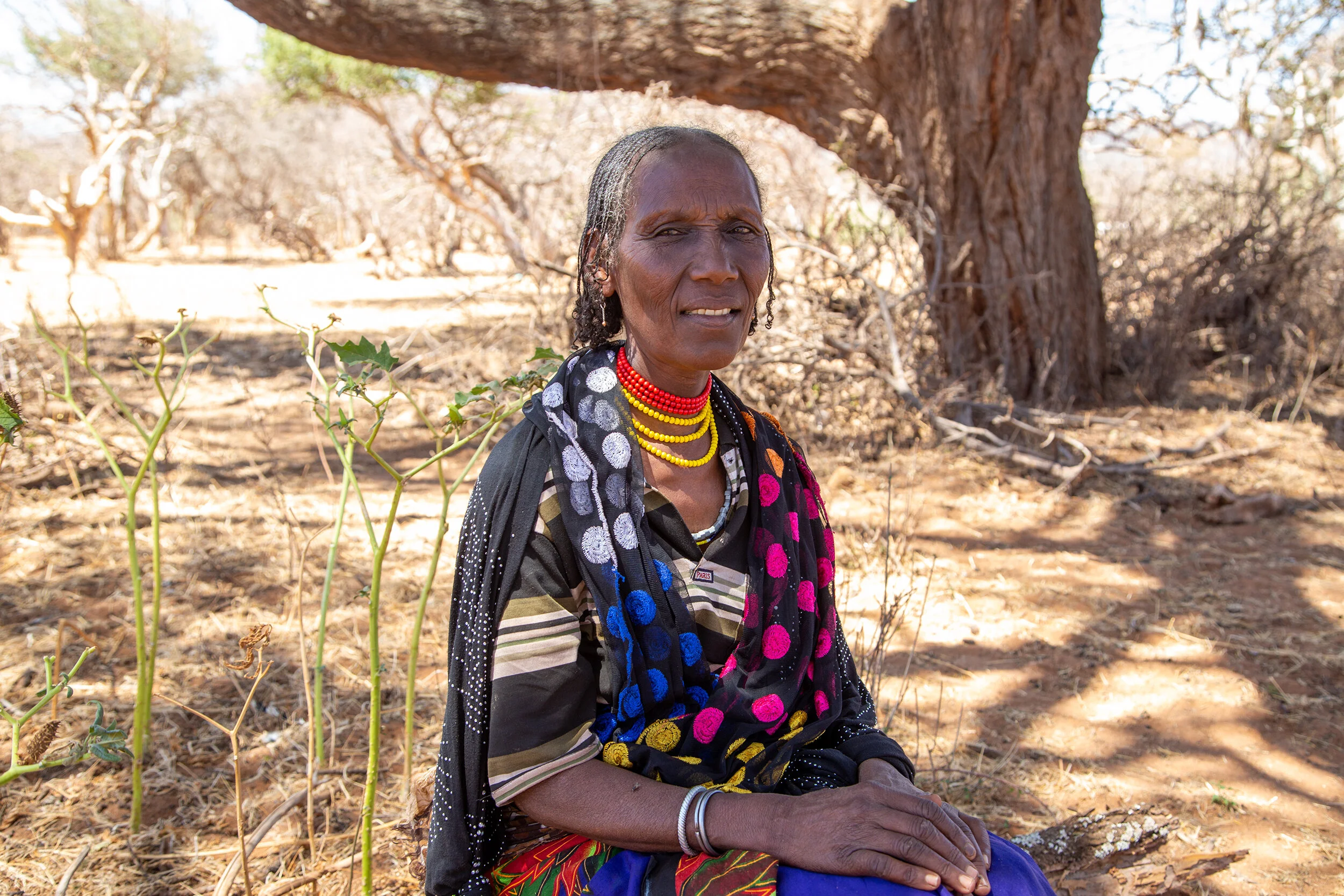


Borena, a southern zone in Ethiopia’s Oromia region bordering Kenya, is home to approximately one million people. It is named after one of the largest subgroups of the Oromo people — the Borana, semi-nomadic pastoralists — whose name means “free.”
Climate change is a harsh and growing reality for the people of Borena. Droughts have become increasingly frequent in this severely water-stressed region, leading to significant losses of livestock and livelihoods, and threatening a traditional way of life.
The following images were taken in 2015 in collaboration with SCIAF, a Scottish NGO working alongside local partners in Borena.
Daki Tadi, 10, tends to her family’s goats.
Access to water is the biggest barrier to girls’ education in Ethiopia’s rural communities. Girls can spend up to six hours a day walking to fetch clean water for their families and livestock. They carry the water in plastic jerry cans, which can weigh up to 20 kilos.
Jilo Dera, 15, fetches water for her family, which is an hour’s walk away. Jilo spends four hours a day walking back and forth to the lake; she does not attend school.
Gilo Huka, in her 90s, brings her cattle every day — sometimes twice a day — to the local watering well with her husband. Gilo talks about a dramatic change in the climate and environment over the last twenty years. Water shortages have completely transformed the landscape of Borena; droughts are becoming longer and more frequent.
Loko Abduba, 30, a mother of five, is a member of a cooperative that produces aloe vera products, supported by a local NGO. The group makes soap, gum, scented wood, and honey, which they sell to a credit union in the nearby town of Yabello. The union shop then distributes the products to buyers across the country.
Loko (left) with other members of an aloe vera cooperative, photographed outside their local store near the town of Yabello. Sales have provided the women with a more stable income and improved their living conditions — giving them better food security, the means to send their children to school, and the ability to afford housing.
Women and girls at an eladu, a shallow water well. They walk for several hours a day — sometimes twice a day — bringing their livestock and fetching water for their families.
Kabo Huka, 36, a mother of four, is an animal herder. She walks her cows and goats every day to an ella, a deep water well. The well was recently rehabilitated, which has improved access and provided cleaner water for local villagers. Before the rehabilitation, Kabo used to walk up to eight kilometres daily for water. Many people became sick from the old water sources. Kabo describes recent years as going from bad to worse in terms of climate change, with less rain, lower water levels in wells, and less grass for the animals.
Kabo greets two young children on her way down to the well. She tells us that women would sometimes give birth during the long walk to fetch water: “Pregnant ladies would even give birth on the road, and the child would be given the name Oba (which means ‘water’) or Oda (which means ‘oak’), the tree they gave birth under. That life has passed.”
Deep water wells found in Borena are called “ellas,” or traditional singing wells. Water is lifted from the well in relay style by a group of men, who sing traditional Borana water songs in unison. The water is poured into a lower trench for the women to collect, and then into a higher trench for the livestock to drink.
Kabo Huka, with her two sons, Cotola, 16, and Aroba, 4, and a niece and nephew
Adi Diba, 30, a mother of three, lives in the village of Elamu. Adi joined a local cooperative set up by a local NGO five years ago and now sells goats and small goods. The cooperative has provided Adi with a steady income for her family and has enabled her to build her own home. Before the coop, she was an animal herder growing up and never had the chance to go to school. She is now able to send her own children to school and hopes for a better life for them.
Adi Diba and her daughter, Dabo, 4.
Loku Gufu, 36, a mother of six and a widow, lives in the village of Ola Aba Alamu. Loku joined a credit union cooperative and took a business skills course run by the local NGO, AFD. She was able to save money through the co-op and take a small loan to start her own business. She now buys and sells goats at a local market. Her eldest son attends university, all her children are in school, and she has built her own house. Life before the co-op was hard for this family, especially after Loku’s husband passed away. They were cattle rearers but struggled more and more due to longer and more frequent dry seasons.
Loku says that when she was a child, water was readily available; there were many streams and rivers, and good pasture for the cattle nearby. Now, it’s the complete opposite—the climate is changing, with too much sun and not enough rain. During the dry season, Loku must walk up to three hours to reach the nearest well.
Loku has lost confidence in relying solely on cattle because of the longer and harsher dry seasons.
Loku with three of her children: daughters Kenamasa, 15, Batatu, 7, and son Galma, 17.
Loku with her mother, Saki, 90, son Dida, 20, daughter Kenamasa, 15, son Daniel, 3, and daughter Batatu, 7, outside the family home. Loku says that since joining the co-op, her life “began to flourish like a plant with enough water. I am a respected woman; I can lead my own life and provide for my children.”